
As Latin America undergoes a massive digital transformation—driven by 5G expansion and aggressive FTTH (Fiber to the Home) rollouts—the demand for reliable connectivity has never been higher. For ISPs and telecom engineering firms from Mexico to Chile, choosing the right fiber optic patch cable is the difference between a seamless network and costly maintenance.
In this 2026 guide, TUOLIMA breaks down everything you need to know about fiber jumpers to optimize your ODN (Optical Distribution Network) and data center performance.
What Is a Fiber Optic Patch Cable?
A fiber optic patch cable (also known as a fiber jumper) is the critical final link in your optical network. It connects active equipment (like OLTs and switches) to the passive fiber infrastructure (ODF and fiber distribution boxes).
For the LATAM market, where network density is increasing rapidly, TUOLIMA focuses on high-precision connectors to ensure minimal signal loss in every “last mile” connection.
Patch Cable vs. Pigtail vs. Backbone Cable
In large-scale telecom projects, using the correct cable type prevents installation bottlenecks.
| Cable Type | Connectors | Best for LATAM Projects | TUOLIMA Recommendation |
| Patch Cable | Both Ends | Connecting OLT to Patch Panels | SC/APC for FTTH |
| Pigtail | One End | Splicing in Splice Trays/FDBs | 900$\mu m$ Easy-strip |
| Backbone | None | Inter-city or Inter-building | G.652.D / G.657.A1 |
Single-Mode vs. Multimode: The LATAM Perspective
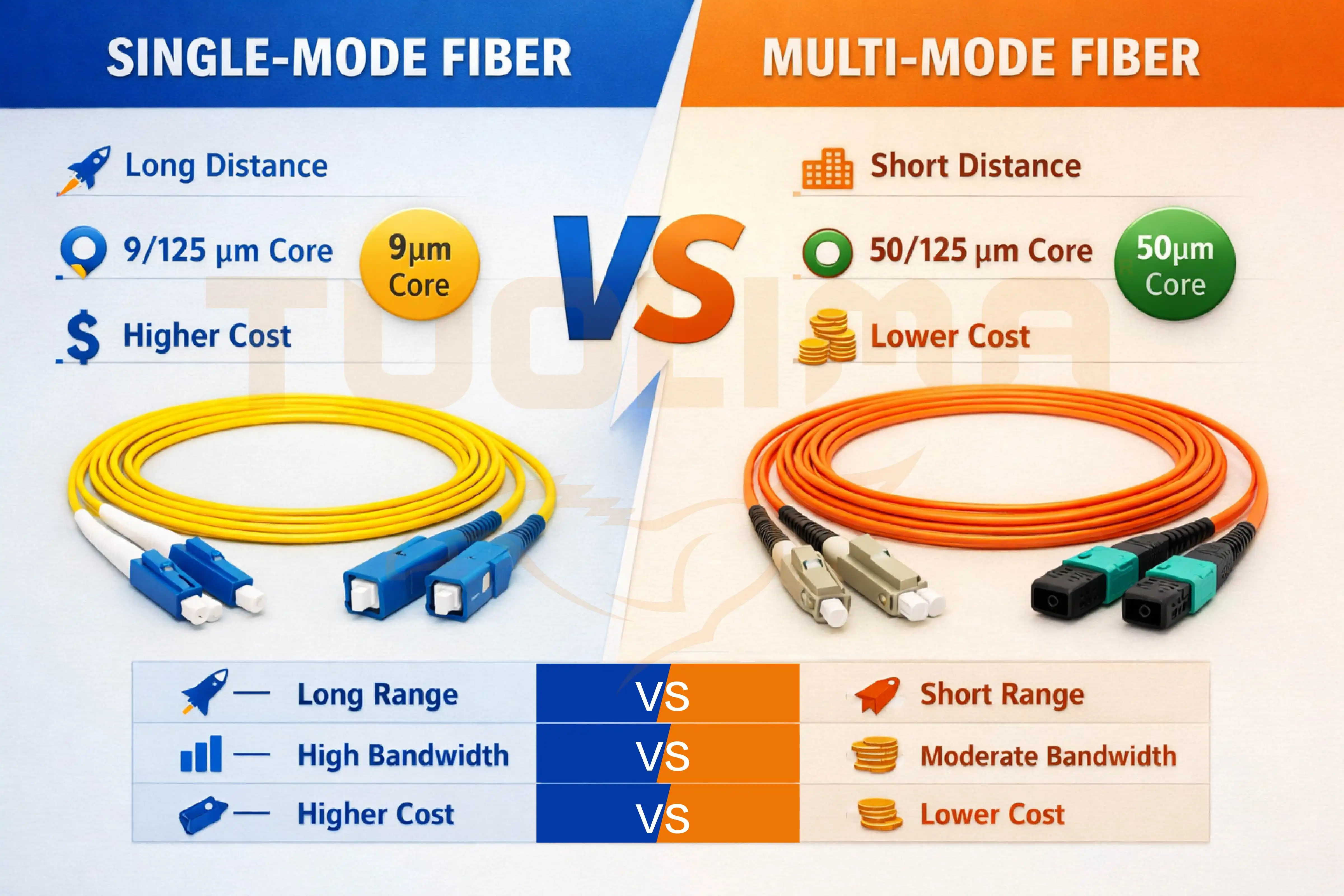
1. Single-Mode (OS2) – The Backbone of FTTH
In Latin America, Single-mode (SM) fiber is the dominant choice due to the vast geographical distances and the prevalence of GPON/XG-PON technology.
- Core: 9/125$\mu m$
- Performance: Supports 10km, 20km, and even 40km links.
- Standard: TUOLIMA’s OS2 cables meet G.657.A standards, offering superior bend-insensitivity for tight enclosures.
2. Multimode (OM3, OM4, OM5) – Emerging in Data Centers
With new data center hubs opening in Brazil and Colombia, Multimode (MM) is essential for short-range, high-bandwidth (40G/100G) indoor applications.
Most Popular Connector Types in Latin America
In our experience serving the LATAM market, two connector types dominate:
SC/APC (Green): The standard for FTTH/PON. The 8-degree angle polish reduces back reflection, which is crucial for video and high-speed data services.
LC/UPC (Blue): The go-to for high-density SFP transceivers and enterprise switches.
MTP/MPO: Increasingly used by Tier-1 operators for rapid data center deployment and 400G migrations.
Specialized Jackets for Diverse Climates
Latin America’s climate varies from tropical humidity to high UV exposure. TUOLIMA offers:
LSZH (Low Smoke Zero Halogen): Essential for indoor safety and compliance with building codes.
Armored Patch Cables: Features a stainless steel layer to protect against rodent damage in rural or industrial deployments.
TPU/Outdoor Jackets: UV-resistant for cables that may be exposed to sunlight in outdoor cabinets.
4 Key Applications in Today’s Telecom Projects
FTTH Deployment: Connecting the NAP (Network Access Point) box to the home.
5G Backhaul: High-speed single-mode links between BBU and RRU.
ODN Infrastructure: Patching within ODFs in central offices.
Campus Networking: Connecting university or government buildings over several kilometers.
How to Choose the Right Cable for Your Project
Follow the TUOLIMA 5-Point Checklist:
Step 1: Confirm the distance (SM for long-haul, MM for short-haul).
Step 2: Select the connector (SC/APC is most common for LATAM FTTH).
Step 3: Choose the jacket (LSZH for indoors, Armored for outdoors).
Step 4: Define the length (Standard 1m, 3m, 5m or custom lengths).
Step 5: Verify Test Reports (Always ask for Insertion Loss < 0.2dB).
Why Partner with TUOLIMA?
As a leading fiber optic product manufacturer, TUOLIMA understands the specific challenges of the Latin American telecom market:
Customization: We provide tailored labeling and lengths to fit your specific ODN design.
High-Volume Production: Rapid lead times to keep your large-scale rollouts on schedule.
Reliability: Every patch cable undergoes rigorous testing (IL, RL, End-face) before shipping.
Regional Support: We have extensive experience shipping to Brazil, Mexico, Peru, Argentina, and beyond, ensuring smooth logistics.
FAQ
Q: Why is SC/APC preferred over SC/UPC in FTTH?
A: SC/APC has a higher Return Loss ($> 60dB$), which prevents signal interference in sensitive GPON/XG-PON equipment common in LATAM.
Q: Can TUOLIMA provide custom lengths for small ISPs?
A: Yes! We support both large telecom operators and growing regional ISPs with custom fiber solutions.